
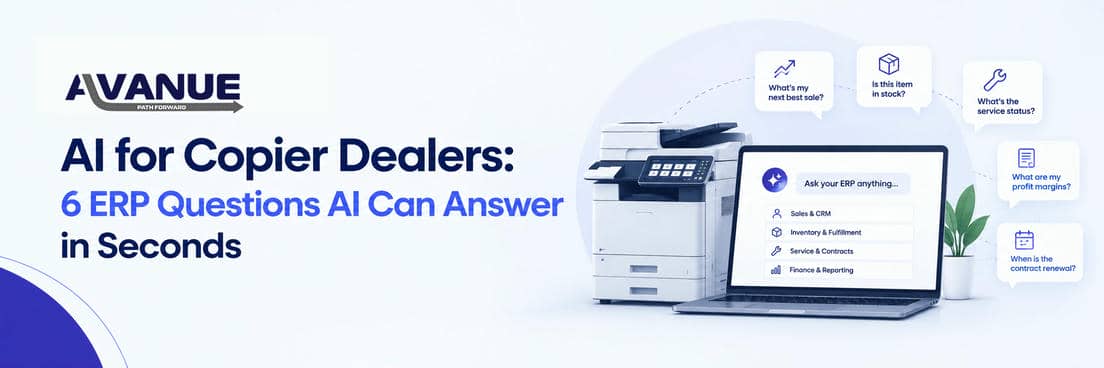

AI for Copier Dealers: 6 ERP Questions AI Can Answer in Seconds
AI for copier dealers works best when it answers everyday operational questions from data already in the ERP. Instead of running and filtering reports, a manager asks a question in plain language and gets an answer from live contract, service and equipment data. The value is speed to the right question, not replacing the judgment of the people who run the dealership.
Your ERP already has the answers. Finding them is the problem.
Office technology and managed print services (MPS) dealers store years of useful data in their ERP: contracts, meter reads, service calls, equipment history and financials. Most of it is hard to reach quickly. A simple question can mean opening several screens, exporting a report and filtering it in Excel.
When answers take too long, decisions wait. A low-margin contract renews on the same terms. A service call ages past its SLA. A customer at risk goes unnoticed. With print volumes declining and margin pressure rising across the US dealer channel, slow answers cost real money.
6 questions dealers can ask AI instead of building a report
- Which contracts have the lowest margins this quarter? AI draws on contract revenue, service cost and supply cost, so you can review pricing and click charges before renewal.
- Which service calls have been open for more than 48 hours? AI draws on service tickets and dispatch status, so you can escalate or reassign technicians.
- Which customers have the most repeat service calls? AI draws on service history by device and account, so you can plan a device swap or account review.
- Which devices are near end of life? AI draws on install date, meter totals and repair history, so you can prepare an upgrade proposal.
- Which accounts have missing meter reads this cycle? AI draws on meter collection status, so you can chase reads before billing closes.
- Which devices show repeat error codes or rising service calls? AI draws on remote monitoring alerts and service history, so you can schedule predictive maintenance before the device fails.
Why AI still needs context and people
AI points to where to look. It does not explain why. A low-margin contract might be underpriced, or it might have high toner usage, frequent breakdowns or unusual terms. A manager still investigates before acting.
The same applies to equipment. An old device is not automatically due for replacement. Contract commitments, customer plans and replacement cost all matter.
The most useful AI setups connect to accurate ERP data, respect user permissions, and let staff check results before acting on them.
From reactive to proactive service
Most dealers still run reactive service: the customer calls, then a technician is dispatched. AI-powered print analytics changes that. By combining remote monitoring alerts, meter trends and service history, AI can highlight devices likely to fail, so technicians handle predictive maintenance on a planned visit, with job details sent to the Service Tech Mobile App instead of an emergency call.
Proactive service lowers cost per service call, protects SLAs and keeps customers productive. It also supports the service-led revenue model many US dealers are moving toward, where uptime matters as much as the equipment itself. AI fits into wider workflow automation too, flagging the next action so staff spend less time searching and more time acting.
How Avanue AI Agent works with SAP Business One
Avanue is Avaniko's division for managed print and office technology dealers. Its All-in-One platform runs dealer operations, including CRM, sales, warehouse, service and contracts, on SAP Business One.
Avanue AI Agent lets users ask questions about that business data in natural language, by typing or by voice. Because it works on the same data as the ERP, the answers reflect the dealership's live operations rather than a separate copy.
For example, a service manager can ask which calls have been open longer than 48 hours and reassign technicians before an SLA is missed, without building a report first.
3 questions to ask before adopting AI
- What problem are we solving? Start with one recurring task, such as reviewing open service calls or spotting low-margin contracts.
- Can the AI reach accurate data? Check that the data exists, is clean enough to trust, and is protected by the right permissions.
- How will we measure success? Record a baseline first, such as hours spent on weekly reporting, then compare after rollout.
Start with one question
AI adoption does not need a major project. Start with a question your team answers every week, and measure the time saved.