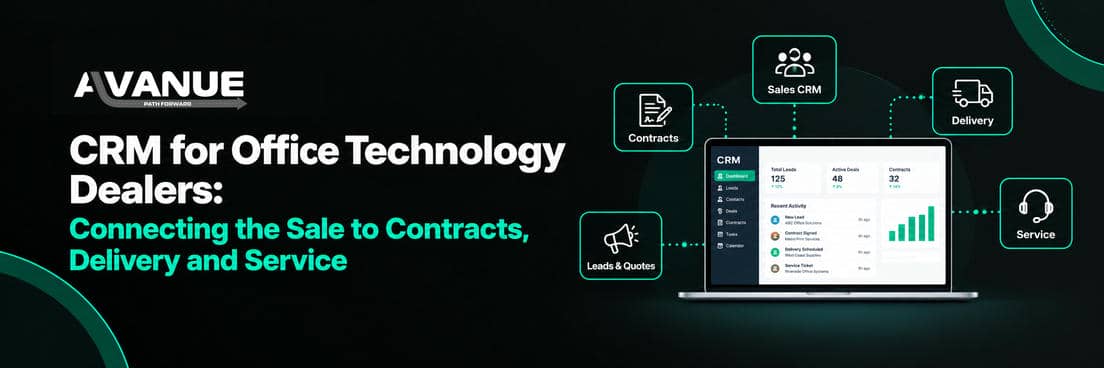

CRM for Office Technology Dealers: Connecting the Sale to Contracts, Delivery and Service
A CRM for office technology dealers should pass deal details straight into orders, contracts, delivery and service. Closing a copier deal starts weeks of work across departments. When the CRM is disconnected from the ERP, each team re-enters the same customer, equipment and pricing details, and mistakes reach the customer.
The sale is the start of the customer journey
After a customer signs, the dealer still has to order equipment, set up the contract and lease, schedule delivery and install, and start service and meter billing. Each step needs information captured during the sale.
Take a new multifunction printer deal. Sales has the customer details, device model and agreed pricing. Operations needs them to order. The contract team needs them for the agreement. Service needs them for the installed base. If each team works in a separate system, the same data is typed four times.
Small gaps cause real problems: a wrong serial number, a missing click rate or a delayed order update. Someone has to stop and investigate.
Why service-led contracts raise the stakes
US dealers are shifting toward service-led revenue to offset margin pressure on hardware. Print-as-a-service, subscription-style MPS agreements and managed IT contracts bundle equipment, service, supplies and support into one recurring fee.
These contracts carry more detail than a one-time equipment sale: SLAs, included volumes, supply terms and renewal dates. Every detail captured in the CRM has to reach contracts, service and billing intact, or the dealer under-bills, misses an SLA or loses the renewal.
Where sales data goes after the deal closes
- Operations and purchasing need the model, accessories, quantities and delivery address to order equipment.
- Contracts and finance need pricing, click charges, term and lease details to set up the agreement.
- Warehouse and technicians need site details, contacts and the install date to deliver and install.
- Service needs device serials, SLA terms and the contract link to support the customer.
- Billing needs contract rates, minimums and the billing cycle to invoice correctly.
CRM and ERP: different jobs, shared data
CRM manages relationships and sales: leads, opportunities, quotes and customer interactions. ERP runs the business: orders, inventory, purchasing, contracts and finance.
When they share data, sales can see open orders and service history before calling a customer. Operations and service get accurate customer and equipment details from day one. No one has to rebuild the customer's history when work moves to another team.
How Avanue connects the customer lifecycle
Avanue is Avaniko's division for managed print and office technology dealers. Its All-in-One platform runs CRM and sales alongside warehouse, service and contract management, all on SAP Business One. Customers can also check tickets, invoices and devices themselves through the Customer Portal.
Because CRM and operations share one platform, a won opportunity can move into the order, the contract and the service record without re-entry. Sales, operations and service work from the same customer and equipment record.
For example, a renewal conversation goes better when the sales rep can see the account's service calls, cost per service call, meter volumes and contract end date before picking up the phone.
4 questions to check your sales-to-service handoff
- How many times is a new customer's data entered between quote and first invoice?
- Can sales see service and billing history before a renewal conversation?
- Does a signed deal create the contract automatically, or does someone rebuild it?
- How long from signature to installed device, and where does it stall?
Connect the full customer lifecycle
A modern dealer CRM covers what happens after the sale, not just before it.